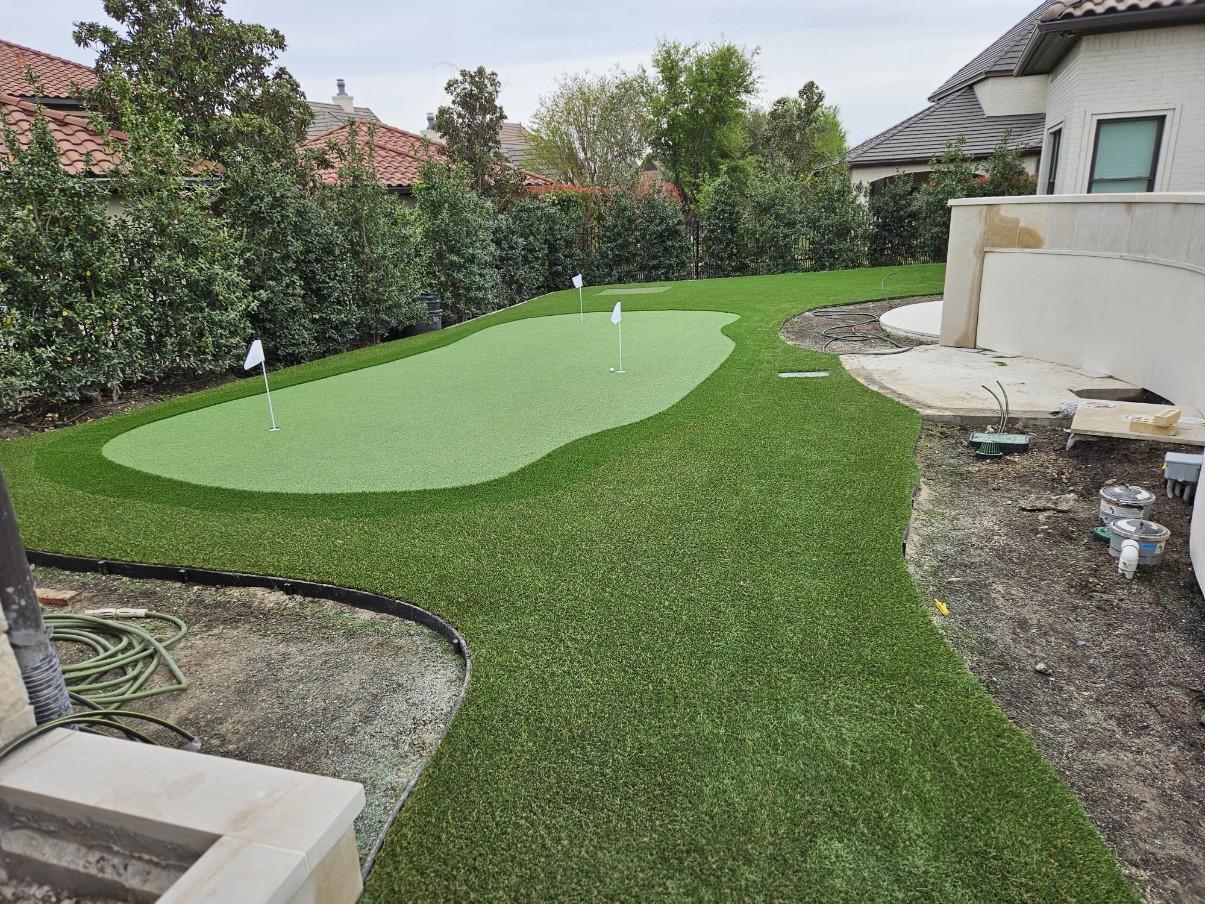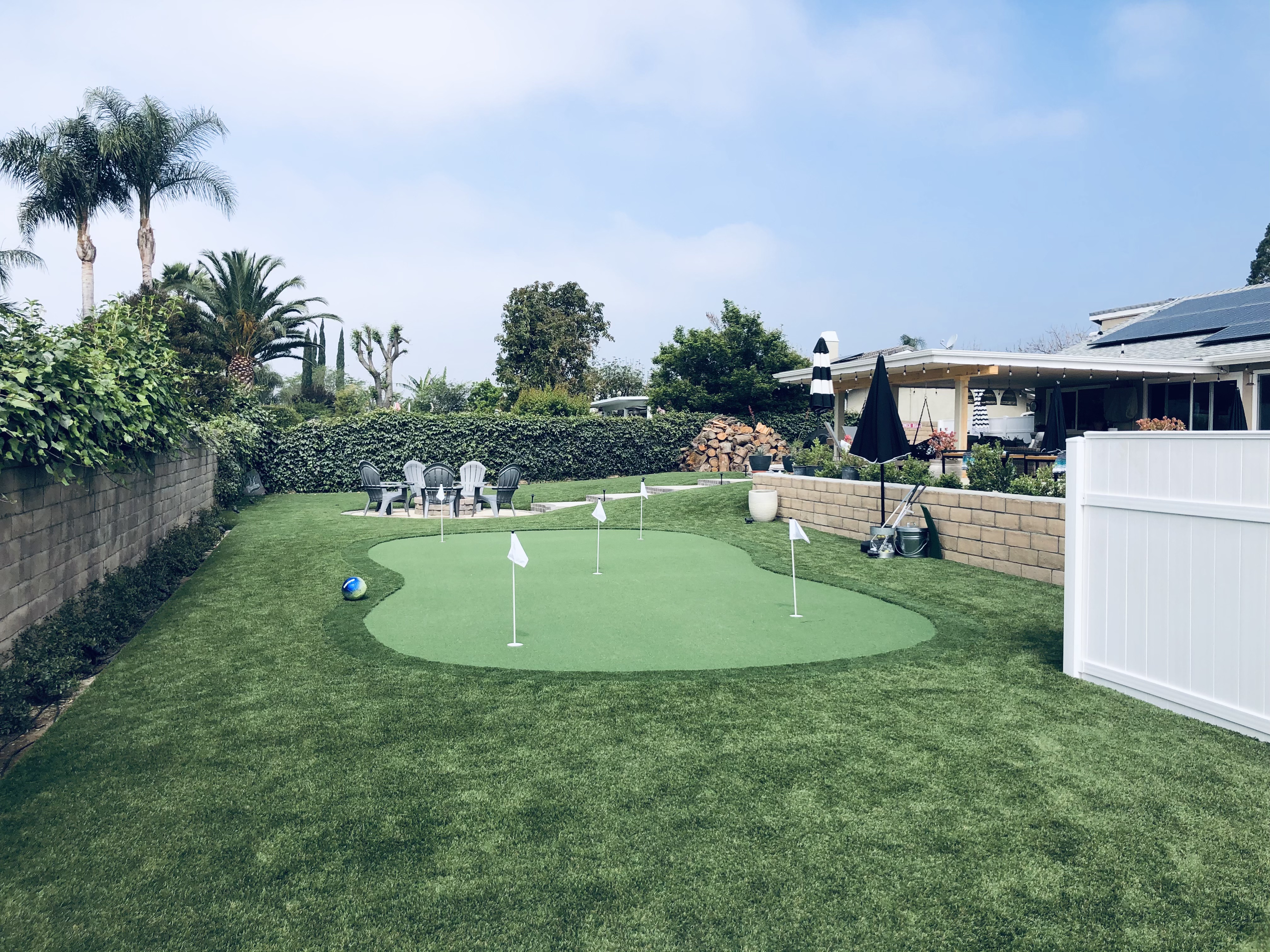
A putting green in the backyard isn’t just for people with sprawling estates. Greens fit in small courtyards, narrow side yards, and standard suburban lots just as well as they fit in large properties.
The key is designing around what you have — and knowing what’s possible.
Here are backyard putting green ideas for every kind of space, along with the design details that make the difference between a novelty feature and a surface you’ll actually practice on.
The Compact Practice Green (200-400 Square Feet)
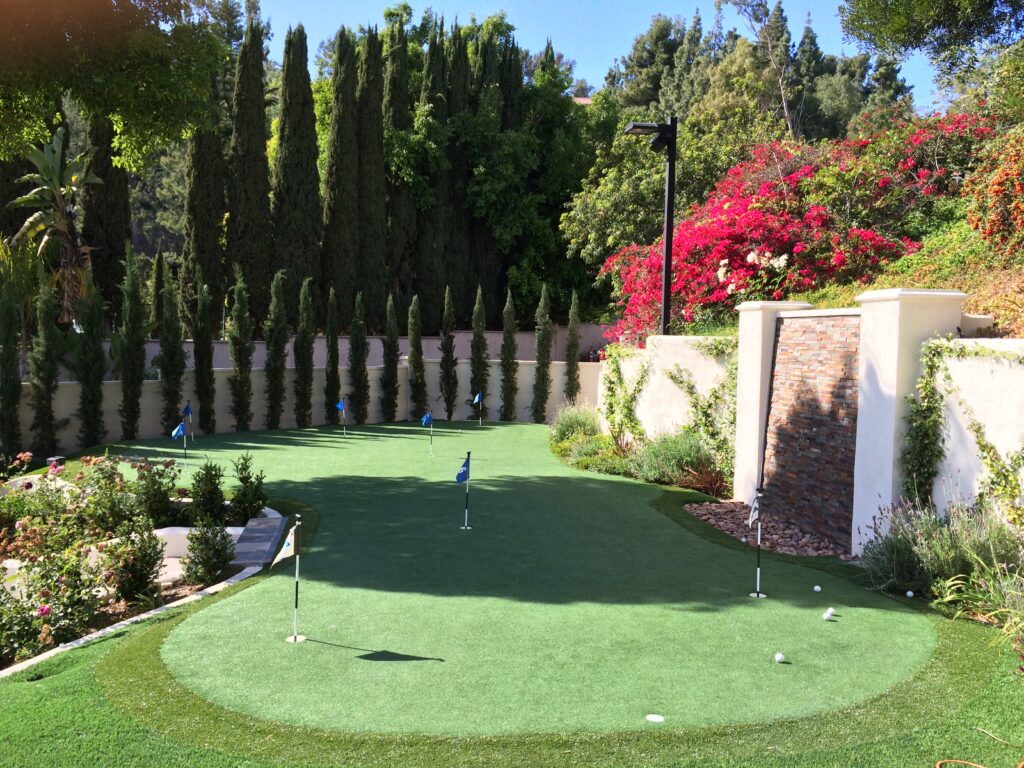
This is the most popular residential putting green size in the DFW area. It fits comfortably in a corner of most backyards without dominating the space.
A green this size typically has 2 to 3 holes, enough to practice a variety of putts without needing to walk across a football field. The shape can be rectangular, kidney-shaped, or free-form depending on your yard layout.
At 200 to 400 square feet, you’ve got room for 10 to 25-foot putts from multiple angles. That covers the distances where most strokes are saved on the course.
Design tip: Place the green where it’s visible from the patio or outdoor living area. It becomes a visual feature of the yard — not something tucked away where you forget about it.
The Full Short Game Complex
For golfers who want to work on more than putting, a short game complex adds chipping areas, fringe zones, and potentially a small bunker or sand trap.
This setup typically runs 500 to 1,000 square feet and includes the putting surface at 0.80 inch pile height for realistic roll, a fringe border at a taller pile height to mimic rough, one or two chipping zones at distances of 10 to 30 yards, and pin positions that force you to practice approach shots from different angles.
This is where the design gets serious. The chipping area needs enough elevation change that chips land on the green with a realistic trajectory. The fringe needs to slow the ball the way real rough does.
Mark A. Du Pont — the owner of Green Forever Turf Texas — has 30+ years of competitive golf experience, including multiple USGA competitions and representing Team USA at the Mercedes-Benz World Cup in Germany. He doesn’t design putting greens like a landscaper. He designs them like a golfer. That means the break patterns, pin placements, and approach angles are built around real practice value.
Multi-Hole Contoured Greens
If you’ve got the space and the commitment to your short game, a multi-hole green with real contour is the ultimate home setup.
We’re talking 800 to 2,000+ square feet with 4 to 6 holes spread across a surface that includes genuine elevation changes, subtle breaks, ridgelines, and undulations that mimic what you’d see at a real club.
This is the type of green where you can play actual rounds with friends. Set up a 6-hole course, grab a putter and a drink, and compete.
Contouring is the hard part. Getting realistic break into a residential green means building the sub-base with carefully shaped mounds and valleys, then laying the turf over them. The turf follows every contour perfectly, creating a surface that reads and plays like an actual green.
Speed tuning adds another level of customization. Removing infill makes the green faster. Adding infill slows it down. Rolling the surface creates a smoother, more consistent roll. You can dial in exactly the speed you want — or change it seasonally.
Putting Greens With Paver Borders

One of the sharpest-looking backyard putting green designs combines the green with a paver border around the perimeter.
The pavers serve double duty: they create a clean visual frame around the green and provide a functional walkway so you’re not wearing paths in the surrounding turf or landscape.
Popular paver materials for green borders include travertine, flagstone, and concrete pavers in neutral tones that complement the green surface.
Add landscape lighting along the paver border, and you’ve got a green you can use after dark. Low-voltage LED path lights or in-ground uplights make the green a nighttime feature, not just a daytime one.
Poolside Putting Greens
A putting green next to the pool is a DFW backyard luxury that’s more common than you might expect. Homeowners in Southlake, Prosper, and Plano are combining pool lounging with putting practice — and it makes perfect sense when you think about the outdoor living culture here.
The design places the green adjacent to the pool deck, usually separated by a paver or coping border. The turf handles splash-over without issue — it drains at 400 inches per hour — and the visual of a green surface next to blue water is striking.
Practical note: golf balls and pools don’t mix. Position pin placements so putts roll away from the pool, not toward it. A slight elevation lip at the pool edge keeps stray balls on the green.
Greens Built Into Slopes
Got a sloped backyard? That’s actually an advantage for a putting green.
Natural slopes let you build elevation changes into the green without massive earthwork. The existing terrain provides the contour — the installer shapes and refines it into a surface with realistic break patterns.
Slopes also create natural tee areas for chipping. Stand at the top, chip down to a green below, and you’ve got a practice setup that mimics real on-course situations.
Many DFW neighborhoods — especially in Flower Mound, Denton, and parts of Frisco — have sloped lots that homeowners view as a landscaping problem. A putting green turns that liability into a feature.
Customization Details That Matter
Pin Positions
Most residential greens have interchangeable cups, so you can move pin positions to change up your practice routine. Standard cup size is 4.25 inches — the same as regulation.
For multi-hole greens, space cups at least 8 to 10 feet apart so putts don’t interfere with each other when you’re playing with someone.
Speed Tuning
This is one of the most underrated features of a backyard green.
Faster greens: Remove some infill. The ball rolls more freely on the fibers, increasing speed. Roll the surface with a lawn roller for an even smoother result.
Slower greens: Add infill. The material between the fibers creates more friction, slowing the ball down.
Realistic feel: 0.80 inch pile height is the standard for putting green turf. It’s tall enough to provide a natural look and short enough for consistent ball roll.
You can adjust speed any time you want. Some homeowners run their green fast in spring and summer when they’re playing more competitive rounds, then slow it down in fall and winter for casual use.
Break and Undulation
Flat greens are fine for basic practice. But if you want to read putts — really read them — the green needs break.
Break comes from the sub-base contouring. Mounds, ridgelines, and subtle slopes underneath the turf create the left-to-right and right-to-left movement that makes putting challenging and realistic.
This is where having a designer with real golf experience pays off. A landscaper can build a pretty green. A golfer builds one that makes you better.
Flags and Accessories
Standard fiberglass flagsticks, numbered flag sets, alignment aids, and even ball-return chutes are all available for residential greens. They’re small details, but they turn a patch of green turf into a space that feels like a real practice facility.
Ideas for Smaller Yards
Even if your DFW backyard is modest, a putting green is still possible.
L-shaped greens wrap around a patio or seating area, using space that would otherwise be dead zones.
Narrow greens along a fence line give you long-distance straight putts without taking up yard width.
Circular or oval greens fit into small spaces and allow putts from 360 degrees around a central cup.
The minimum practical size for a putting green is about 100 to 150 square feet — roughly a 10×10 or 10×15 area. That’s enough for a single hole with 6 to 12-foot putts from multiple directions. Small, but genuinely useful for practice.
Get a Green Designed for Your Yard
Every backyard is different, and the best putting green design fits your space, your playing goals, and your overall yard plan. Whether it’s a compact 2-hole practice surface or a full contoured complex, the putting green installation process starts with a conversation about what you want.
For step-by-step guidance on building one yourself, check out our DIY putting green guide.
Ready to see what artificial turf can do for your yard? Call us at 844-91-GREEN (844-914-7336) or request a free quote.